A field manual for FrontWars
The gold loop in numbers
Gold buys everything, and three buildings make it: cities raise the ceiling on troops, factories lay rails that trains run on, and ports send trade ships that pay both ends of the route. All three cost 125,000.
- TESTEDthe ten prices and the HUD readout, 2026-11-03
- IN-GAMEthe factory, port and railroad lines, quoted from Instructions
- OFFICIAL ONLYSteam calls a match minutes rather than hours; that is Valve's line
- NEEDS CHECKgold per minute, train payout per visit, trade-ship amount
All ten prices
| Building | What the tooltip says | Cost |
|---|---|---|
| City | Increases max population | 125,000 |
| Factory | Produces units | 125,000 |
| Port | Allows naval units | 125,000 |
| Defense Post | Increases defenses | 50,000 |
| Missile Silo | Launches missiles | 1,000,000 |
| SAM Launcher | Anti-aircraft defense | 1,500,000 |
| Warship | Battleship unit | 250,000 |
| Atom Bomb | Nuclear weapon | 750,000 |
| Hydrogen Bomb | Thermonuclear weapon | 5,000,000 |
| MIRV | Multiple independently targetable warheads | 35,000,000 |
The client abbreviates: 125K, 1.00M, 35.0M. The table prints the digits, because a thousand here or there is a city.
Two entries carry different descriptions in two places in the same build. The build-bar tooltip calls a factory something that creates railroads and spawns trains; the build menu calls the same factory something that produces units. The port is sends trade ships to generate gold in one and allows naval units in the other. We quote both rather than pick.
What the HUD actually shows
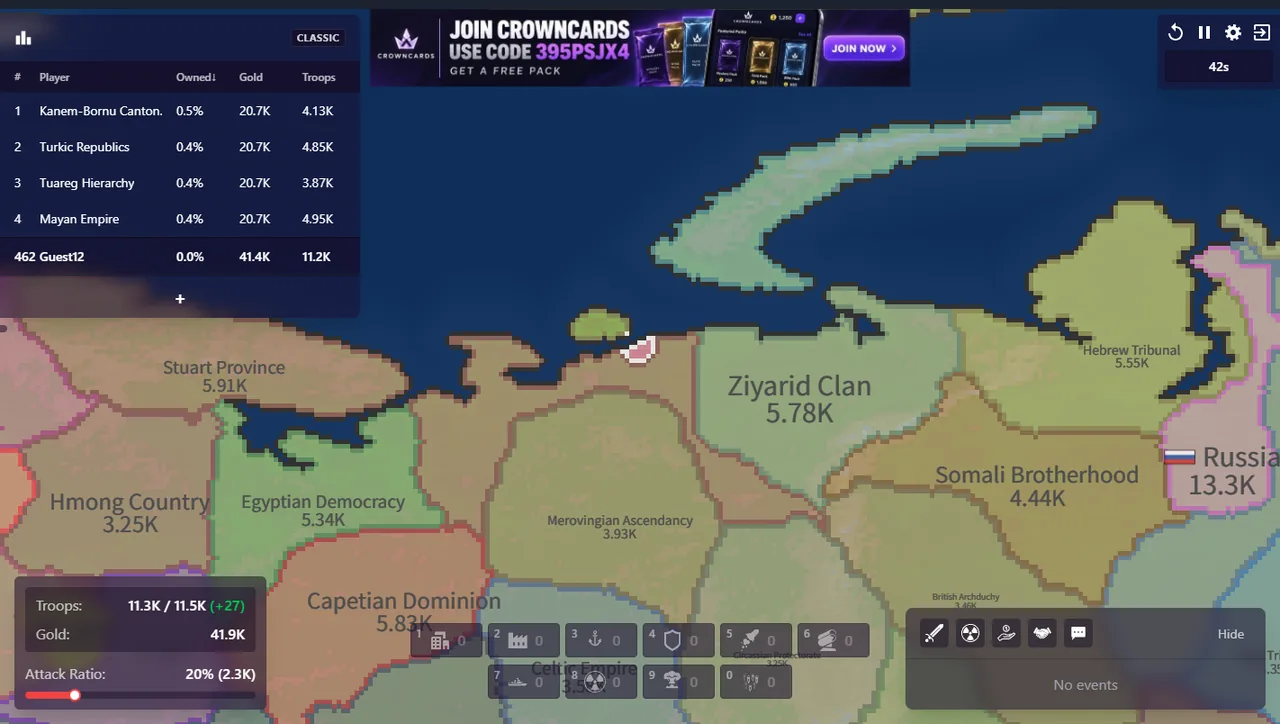
There is no income figure anywhere on the screen. You get a gold balance and a troop line of the form current / maximum (+growth). Everything else about your economy you learn from watching the balance move, or from the leaderboard's Gold column, which every player has.
That is worth knowing before you compare notes with anyone: a guide that quotes "gold per second" is quoting something the client does not display.
The loop, in the order it pays
City raises the troop ceiling, so the growth line keeps climbing instead of flattening. Factory lays rails toward nearby cities, ports and factories — you do not place track, the building does — and trains pay on every visit. Port needs water, sends trade ships, and both ends of the route are paid; a warship can capture those ships, which is why a port wants a warship near it.
Rails connect to friendly buildings as well as your own, which is the detail most guides skip: a line that runs through an ally's city keeps paying.
What we have not measured
We did not time the loop. Gold per minute, the payout of one train visit and the size of a trade-ship payment are all absent from this page, because measuring them needs a controlled run with a stopwatch and one variable at a time, and a single match is not that run. They are the first experiments in the next session.
Until then the honest build order is the cheap one: a defence post at 50,000 first if a border is contested, then a city, then a factory. Buying a missile silo at 1,000,000 before your second city is how a promising start stalls.
Last checked against the client: 2026-11-03 · client v42.5